
War is all around us.
I’m not much for war movies, but 1917 was pretty ok. Much like Dunkirk before it, Sam Mendes took the “big war, small story” approach, which I much appreciate over bloody epic battles or tense displays of strategy. The production design was impeccable and a joy to watch, and the relative unknown lead actors (with appropriately haunted old-fashioned faces) wore the story just right. I’m not 100% sure if they were acting or just genuinely traumatized by what they were experiencing, but it’s unimportant. I only looked at my watch in the last half hour and I even got a little misty at the appropriate times.
Some gimmicky weirdness
The big thing about 1917 that is getting everyone so hyped (and 100% why the directoral Academy nod was given) is the whole “illusion of one continuous take” thing, and I’m just not on board. Which is interesting, because the same trick worked great for me with Birdman. But dreamlike timelines work in a movie that’s doing the magical realism dance – not so much with a hyperrealistic war film. The moments in 1917 where the gimmick of continuousness felt most unwanted is when the movie shifted into a sense of unrealness. It kicked me out of the story. The awkwardly compressed time, the too convenient blackouts and explosions… I was more consumed with finding the seams between scenes than I was at the plot itself.
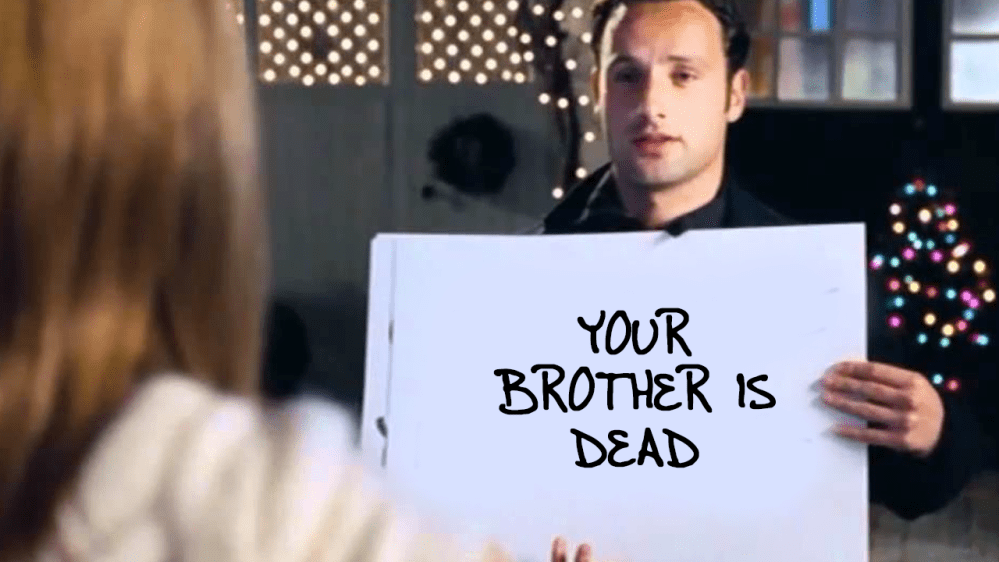
Tell them it’s carol singers.
About that plot
Too often, dramatic movies that are trying to be taken seriously go too hard with the tragedy (I hate it). 1917 wasn’t guilty of that, but just as bad/possibly worse are dramatic movies that tie up their sadness into a neat and satisfying bow by the end. If you look at 1917 too closely, it feels less like a war drama with a sensitive heart and more like a Hallmark movie that someone took out back and tried put down like Old Yeller. Weave in celebrity cameos by Dr. Strange, Hot Priest, and Mr. Fucking Darcy, and suddenly, it’s really just Love Actually – but instead of running through the airport to stop his crush from getting on a plane and leaving before he can tell her how he feels, our protagonist is running through a battlefield to try and stop a doomed attack plan and tell his fallen friend’s brother that he died with honor. It’s all very noble and sweet, and couldn’t possibly have been more contrived if Rick Grimes showed up with cue cards to deliver the message himself. It wasn’t bad, exactly, but the acting and the cinematography deserved better than the script had to offer.
I liked it in the moment, but I don’t think 1917 is going to hold up in the long run – which means about an 85% chance of a Best Director win for Sam Mendes.
 The Oscar Dump